
Achieving Sustainable Development Goal 3 (SDG 3), Good health and well-being, requires health systems that enable all people to live healthy, independent and dignified lives. Yet for millions of people with disabilities, injuries or age-related impairments, access to essential assistive technology (AT) remains limited or unavailable.
Through the collaboration between the Royal Academy of Engineering and UCL Global Disability Innovation (GDI) Hub’s AT2030 Programme, funded by UK International Development, the AT2030 Frontiers Symposium and Seed Funded projects are helping drive progress towards more inclusive health systems and the achievement of SDG 3. Held in Kathmandu, Nepal, in October 2025, the symposium brought together researchers, practitioners, innovators, policymakers and people with lived experience to explore how assistive technology can strengthen health systems and expand access to care. Alongside the symposium, a portfolio of AT2030 seed-funded innovation projects is demonstrating practical approaches to improving mobility, rehabilitation, mental wellbeing and inclusion, highlighting the vital role of assistive technology in advancing health and wellbeing for all.
A central message emerged throughout the discussions: equitable access to assistive technology is an important component of Universal Health Coverage (UHC).
Case study
Symbiotic leadership in AT (women with disabilities)
One in six people worldwide live with a significant disability, highlighting the need for health systems and assistive technologies to respond to the diversity and scale of people’s needs.
Despite this demand, access to healthcare and assistive technology remains inequitable because of systemic barriers and limited representation. Top-down design processes can overlook the specific needs of marginalised groups, particularly women with disabilities.
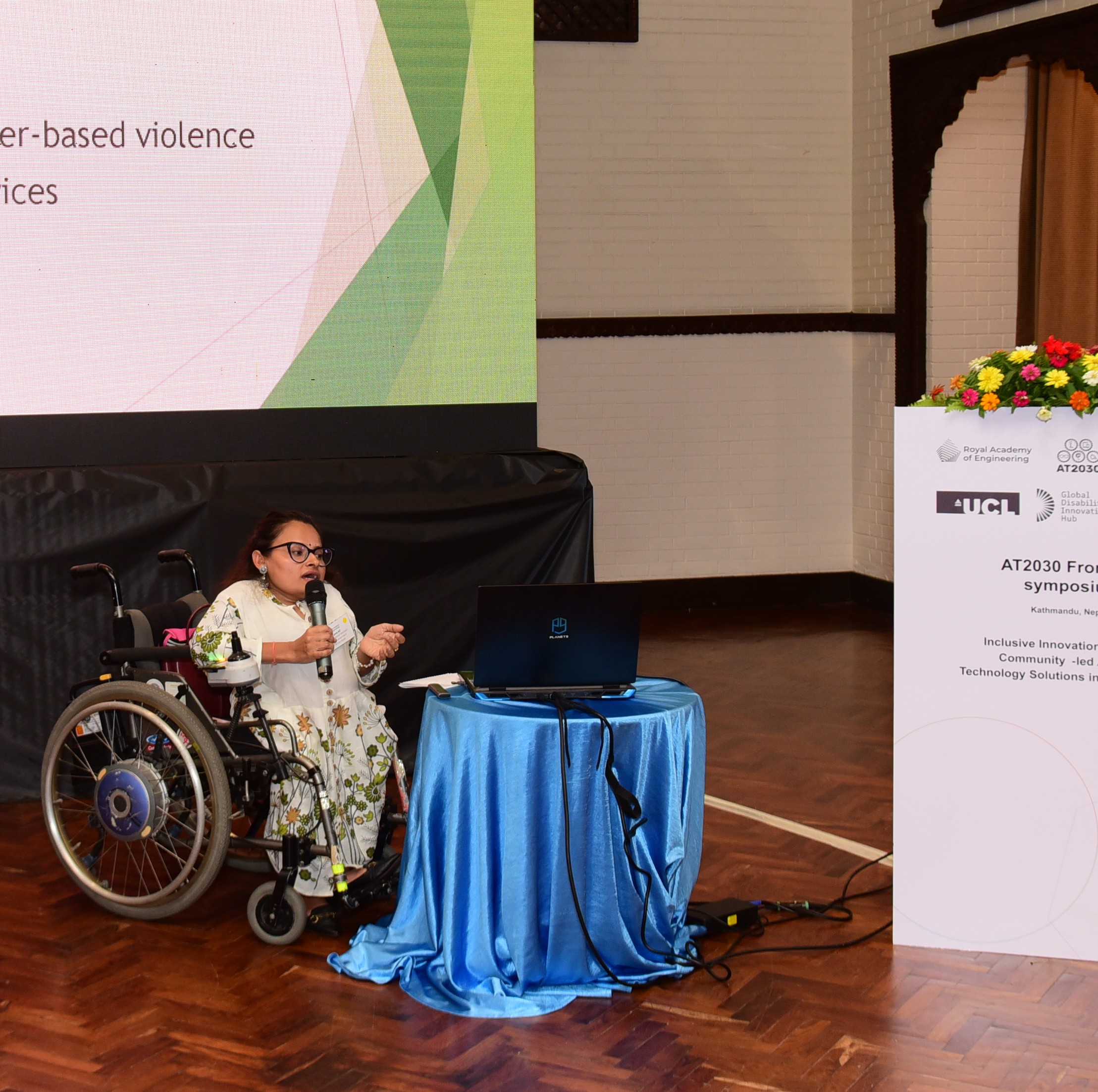
The Symbiotic Leadership in AT seed funded project, led by Anjana K.C., is exploring ways to ensure women with disabilities are recognised as leaders and co-designers, as well as service users. The initiative challenges traditional governance structures and improves the relevance and accessibility of assistive technology by giving women a meaningful role in decision-making.
Combining systemic leadership training with community-led inclusion, this initiative shows how health systems can become more responsive and equitable when people with lived experience are involved from the outset. Early work suggests that centering lived experience can help better target interventions and address gender- and disability-based barriers to essential health services.
Insights

Discussions during the symposium identified several priorities for strengthening inclusive health systems:
- Assistive technology is part of healthcare. AT should be recognised as a core part of health services rather than a specialist or optional intervention. Mobility, communication, rehabilitation and independence are fundamental to health and wellbeing.
- Rehabilitation is essential. Participants highlighted rehabilitation as a critical but often underfunded part of health systems. Expanding rehabilitation services is essential to achieving UHC and helping people maintain or regain independence.
- Workforce development matters. Devices alone do not improve health outcomes. Skilled professionals, appropriate assessments and ongoing support are needed for safe and effective service delivery.
- Inclusion improves outcomes. People with disabilities must be involved in designing products, services, and policies. Co-design can lead to more relevant solutions and more responsive health systems.
- Innovation must be sustainable. Digital platforms, local manufacturing and repair ecosystems can increase access and continuity of support when backed by strong partnerships, skills and long-term planning.
SDG 3 in action: sustaining mobility through repair and maintenance
People’s assistive technology needs can change over time as their physical abilities and environments change. Access to AT therefore depends on long-term maintenance and upgrades, as well as initial provision. Countries such as Nepal, where local AT manufacturing and repair infrastructure is limited, continue to face challenges in this area. Repairs are an important part of sustaining access to AT and rehabilitation.
Providing a wheelchair is often viewed as the end of a service journey. In reality, it is only the beginning. Across many low-resource settings, wheelchair users face significant barriers when equipment breaks down. Without access to timely maintenance, a damaged wheelchair can result in reduced mobility, increased risk of injury, loss of opportunities, and social isolation.
Bikash Wheelchair and Mobility Assistive Technology Repair Centre seed funded project, led by Rajuna Singh, addresses this issue by providing affordable local repair services to keep equipment safe and functional. This can extend product lifespans and help users maintain mobility and independence.
The centre also contributes to wider efforts to strengthen wheelchair provision, fabrication, fitting, repair and user support. These efforts recognise wheelchair provision as a continuous service, highlighting the importance of professional skills and ongoing support. By improving practitioner capacity and local repair systems, assistive technology can become more sustainable, appropriate and accessible.
This is inclusive health systems in action – strengthening services and making assistive technology more appropriate and accessible. A wheelchair improves health and independence when it meets the user’s needs and is supported through ongoing care. When professionals have the right skills and users are central to decision-making, assistive technology becomes a pathway to health, dignity, independence and inclusion.
AT is not charity; it’s a bridge to dignity. - Anjana K.C.
Resources
Additional insights, reflections and recommendations from symposium participants can be found in: