
Key findings of the paper
This challenge paper explores how dual‑use is currently understood and applied in practice, and what this reveals about wider tensions in technology governance. It is not a prescriptive policy report, and it does not seek to offer definitive solutions. Instead, it aims to surface the trade‑offs that decision‑makers face when governing technologies that sit across civilian and military domains. It considers examples from research, security, export controls and defence innovation.
We set out to explore how the term is applied in practice and whether a shared understanding is needed. We conducted desk-based research and interviews with a few key stakeholders. This paper summarises what we learned: how the term is understood and applied; where inconsistencies arise and how these reveal wider policy tensions
We want to start a national conversation - because getting this right can unlock new technologies for the UK in a way which bring benefits to all.

What is dual-use technology?
Dual-use is a term broadly applied to items with both civilian and military applications. It originated post-WWII during the nuclear arms race where the overlap of nuclear weapons and nuclear power generation led to the first necessitation of dual-use technology. Prior to this, most military technology and civilian technology was largely distinct and separate. WWII similarly saw the development of radar, which led to major advances in electronic engineering and later benefited everyday household technologies.
The current landscape is far more complex. Technologies have proliferated and innovation happens at pace. Military innovation is no longer solely driven by the government, with a larger proportion of innovation coming from the commercial sector before being adopted into defence acquisition pipelines. Lines between civilian and military applications have become increasingly blurred, with items ranging from hobbyist drones to cloud computing software considered dual-use, with visible applications in Ukraine. The concept of dual-use has expanded so much that military applications are now only one consideration among many, with broader national security considerations such as resilience, sovereignty, and cyber- and economic security all now in play.
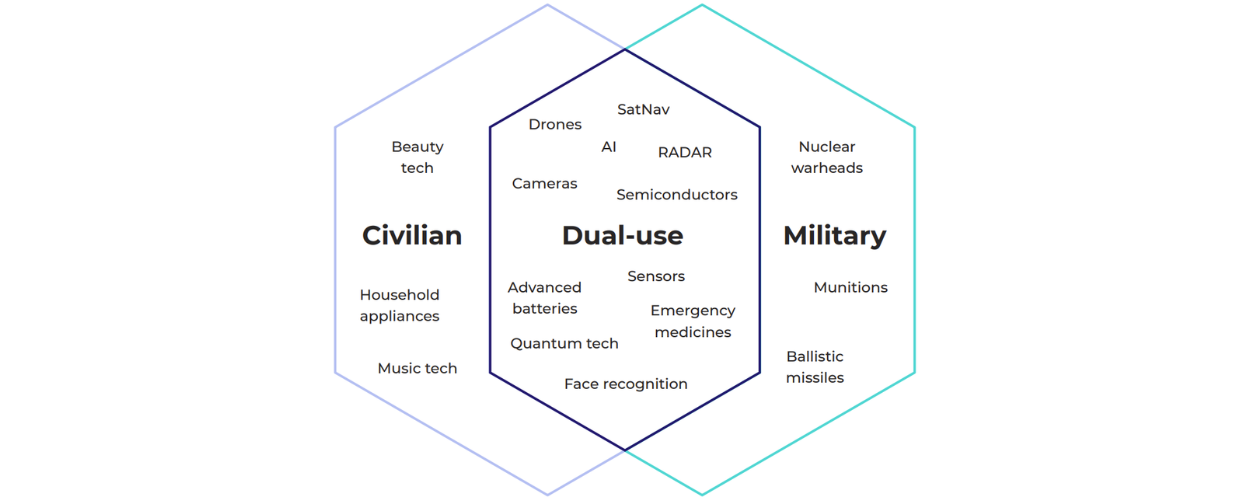
Three intersecting hexagons arranged as a Venn diagram. The left hexagon is title 'Civilian' and contains the words, Beauty tech, Household appliances, music tech. The middle hexagon is titled 'Dual-use' and contains the words, SatNav, Drones, AI, RADAR, Cameras, Semiconductors, Advanced batteries, Sensors, Quantum tech, Emergency medicines, Face recognition. The right hexagon is labelled 'Military' and contains the words, Nuclear Warheads, Munitions, Ballistic missiles.
A case study: cement mixers in Ukraine
This challenge paper illustrates numerous examples where the tensions and conflicting objectives of the term dual-use can result in contradictory examples.
One example is the EU banning the export of cement mixers to Russia following its invasion of Ukraine in April 2022, because it became clear that they were being used to manufacture storage facilities for nuclear missiles.
Cement mixers are not typically considered dual-use goods in the traditional sense, where an item has inherent characteristics that lend themselves to both civilian and military applications. However, this case illustrates a broader shift in export controls, where items can be treated as if they were dual-use based on their anticipated end-use. Controls in this context are no longer defined solely by the intrinsic properties of goods, but instead by the risks associated with how and by whom they are used.

A new definition for dual-use technology
All groups involved in the discussion around dual-use needs confidence and clarity on how best to proceed, and a coordinating body able to straddle the military and civilian worlds would be crucial for ensuring ownership and quick responses to emerging technological threats.
In this challenge paper, we have proposed four tools that support a more coherent approach. They are not intended to guarantee the same outcome across multiple stakeholders but instead provide an element of standardisation to the decision-making process.
Tool 1: a dual-use recognition spectrum
A linear spectrum placing dual-use items along the Research and innovation pipeline, highlighting when and where dual-use potential emerges.
Tool 2: a policy trade-off matrix
A matrix mapping different scenarios against policy objectives, with each cell illustrating a trade-off, a win-win or a lose-lose.
Tool 3: a civil-military advantage quadrant
A quadrant chart categorising technologies by their sector of origin and dominant advantage sector (civilian v military).
Tool 4: Participatory Systems Mapping exercise
An exercise identifying how different systems that seek to govern and steward dual-use technologies interact in practise and identify intervention points for change.
It is worth noting that these options are geared towards tangible technologies and would not be appropriate for platform digital technologies.
Conclusion - a national conversation is needed

Modern technology is not just complex in nature but complex to govern. Our current approach relies on old assumptions that in many cases are no longer valid. This challenge paper has exposed deeper policy tensions beyond questions of terminology and categorisation. Addressing these tensions demands much broader conversations about the UK’s approach to national security, economic policy and sovereignty.
We believe the Academy is well positioned to act as a neutral convener, bringing together stakeholders across sectors who may be grappling with these challenges in isolation. The stakeholders we have consulted thus far have all expressed an appetite for surfacing tensions and a wider discussion on the UK’s approach to technology governance across the various contexts in which it is applied.
We encourage the whole engineering community to have deeper discussions about the terminology and governance surrounding the term dual-use.
Contact us
For further information about this project or if you have questions, please contact Arizona Rodriguez.
Related content
Quantum – a critical technology for a critical time?
The Royal Academy of Engineering recently hosted a Critical Conversation with Professor Melissa Mather and Professor Pe…
Research and Innovation
Informing policy and shaping the environment so that engineering R&D and innovation thrives in the UK.
Strategic advantage through science and technology
Science and technology being harnessed purposefully to achieve defined outcomes for security, prosperity, resilience, i…
Research and Innovation Ecosystem
Strengthening the foundations of the UK’s research and innovation ecosystem will allow for technologies to thrive. We a…