
Professor Caldwell began his career as an apprentice in the Vickers-Armstrong shipyard in Barrow-in-Furness in 1943 and went on to become one of the UK’s most distinguished naval architects,. As an academic at the University of Newcastle, he specialised in design and structural safety at a time when Britain built half the world’s ships, compared with fewer than 1% today.
On 11 June 1976 he joined nearly 130 leading engineers at the inaugural meeting of the Fellowship of Engineering, which was hosted at Buckingham Palace by its Founding Senior Fellow, HRH The Prince Philip, Duke of Edinburgh, who had personally championed the formation of the Fellowship. In one of his last interviews about the Academy’s work, for Radio 4’s Today programme in 2015, Prince Philip said: “Everything that wasn’t invented by God was invented by an engineer.”
Along with HRH The Duke of Kent, HRH The Princess Royal has been a Royal Fellow of the Academy since 2010, championing and supporting the profession and promoting engineering as a career. When asked in an interview with Vanity Fair magazine what alternative career she might have considered, Her Royal Highness said she would have become an engineer.
In 2021, Her Royal Highness met with Professor Caldwell to discuss the founding of the Academy, which celebrates its 50th anniversary this year. They discussed his career as a naval architect, training students and working with the busy shipyards on the River Tyne. https://www.youtube.com/watch?v=AYouu7e9m7Y
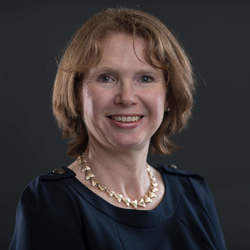
Her Royal Highness recalled that the first ship she launched was the Esso Northumbria, at the time the largest vessel ever built in Britain. Professor Caldwell had attended the launch on 2 May 1969 and confessed that the launch calculations were difficult with such large ships as too much grease on the slipway could have risked the huge tanker sliding too fast and ending up on the other side of the river. Fortunately, the launch went perfectly on the day. https://www.youtube.com/watch?v=2Ql1dkLT4go
Professor Caldwell’s son Phil Caldwell says: “Dad's 100th birthday was a really joyful occasion, and we marked the event in fine fashion at a lunch with family and friends near his home in Cumbria. Dad was on great form and he was thrilled to receive the letter from HRH The Princess Royal, which we read out to him in front of everyone. We could tell he was quite taken with the special words of praise for his service.”
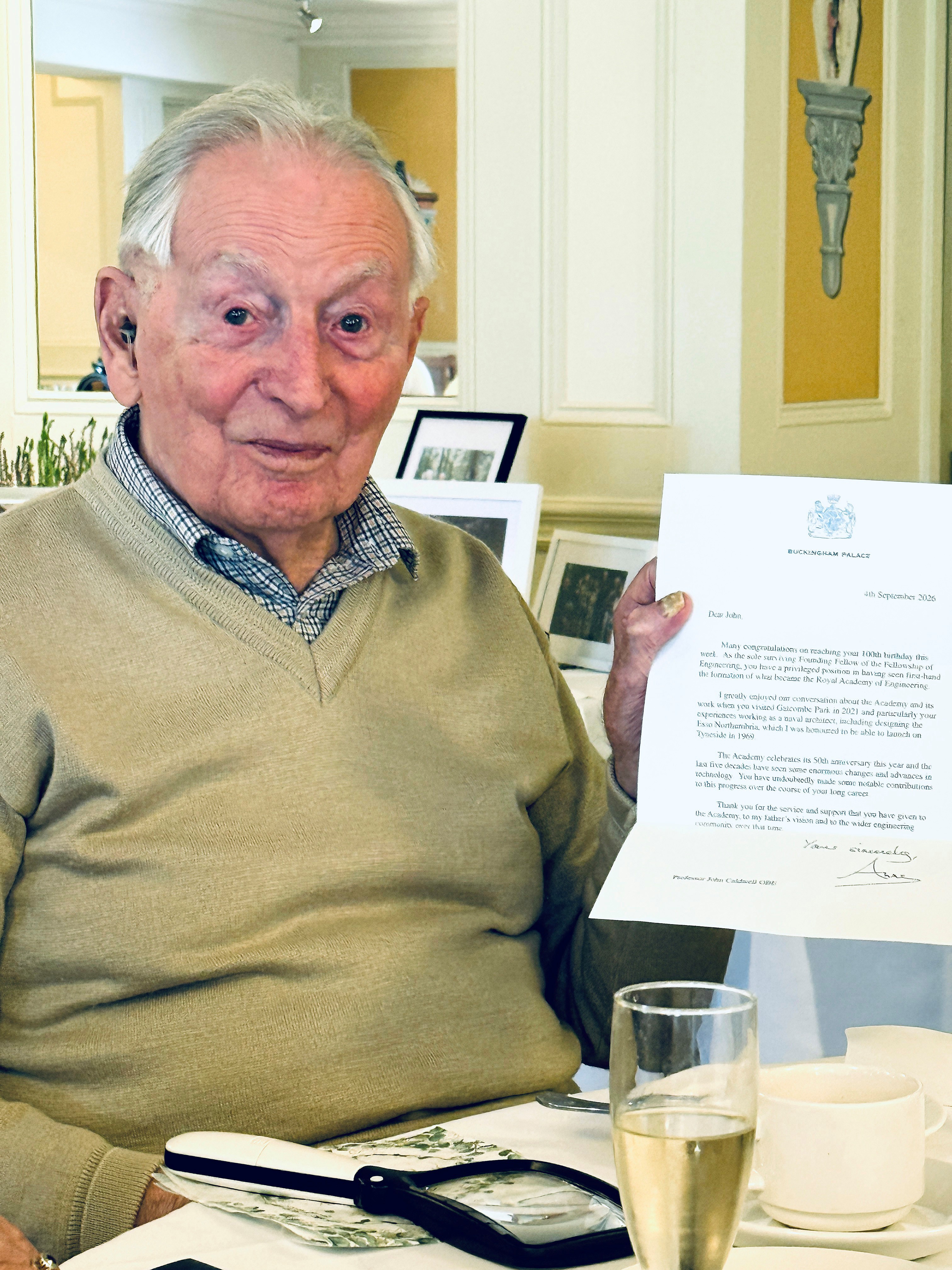
Founder Fellow Professor John Caldwell OBE FREng receiving a letter from HRH The Princess Royal on his 100th birthday (Photo: Mike Caldwell)
Notes for editors
1. Engineering better lives for 50 years
Conceived during the excitement of the Apollo space programme and the buzz of Prime Minister Harold Wilson’s ‘white heat of technology’, the Royal Academy of Engineering was born in 1976, the year of Concorde’s first commercial flight.
The first 130 Fellows were some of the most brilliant minds of the time. They included the jet engine genius Sir Frank Whittle, design guru Sir Ove Arup, radar pioneer Sir George MacFarlane, bouncing bomb inventor Sir Barnes Wallis, and Sir Maurice Wilkes, father of the UK computer industry.
Today the Academy has over 1,700 Fellows and the boundaries of engineering have expanded more rapidly that anyone could have predicted 50 years ago. From optical fibre communications and artificial intelligence to engineering biology and graphene, engineers are changing the world.
2. The Royal Academy of Engineering creates and leads a community of outstanding experts and innovators to engineer better lives. As a charity and a Fellowship, we deliver public benefit from excellence in engineering and technology and convene leading businesspeople, entrepreneurs, innovators and academics across engineering and technology. As a National Academy, we provide leadership for engineering and technology, and independent, expert advice to policymakers in the UK and beyond.
Our work is enabled by funding from the Department for Business, Innovation, Science and Trade, corporate and university partners, charitable trusts and foundations, and individual donors.