
For founders, the opportunity to step outside their own silos and test ideas with people who do not share their assumptions or vocabulary is invaluable. Across the country at the People’s AI Stewardship Summits, we saw how a diversity of perspectives can challenge thinking, generate new insights and help entrepreneurs reframe the problems they are trying to solve. As one founder said, these summits offered an important “sense check”. Engineering and technology are at their best when they improve lives, and these events created space to hear directly from the people and communities who may be affected by new technologies.
The importance of listening
Strong founders already know the value of understanding their users. What the summits highlighted, however, is that innovation also benefits from hearing a broader set of voices, including people who may not be direct customers but who will still experience the effects of a technology in their everyday lives.
Opportunities for that kind of direct, open dialogue are still rare. Hub Members who attended the summits described the conversations as “eye-opening”, “unexpectedly honest”, and “something we need more of”. They came away with a richer understanding of how people interpret emerging technologies, alongside a sharper awareness of the ethical and practical questions that can shape adoption.
That matters because even the most clearly defined product or service can have consequences beyond its immediate market. The summits reinforced that understanding impact means looking not only at who buys a technology, but also at who lives with it.
In practice, entrepreneurs can become understandably focused on their core market. But public perspectives can surface impacts, risks and needs that would otherwise be missed. Listening to the public helps close that gap.
Take AI in healthcare. A company’s immediate customer might be a hospital, health system or pharmaceutical business. But the effects of that technology are often felt much more widely by patients, families and the public. That is why these wider perspectives matter: the people affected by a technology are not always the people procuring it.
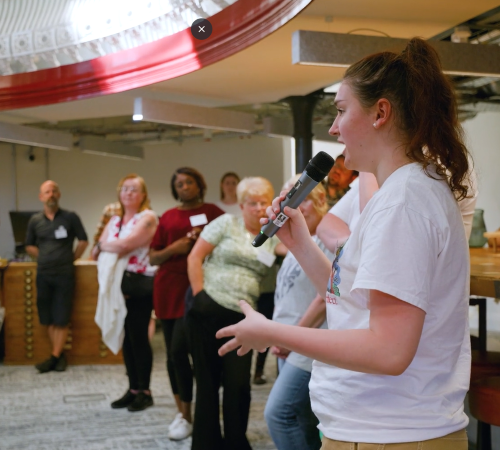
This is also why the summits focused on practical examples of AI already in use, or likely to be used soon, rather than abstract scenarios. In Wales, one discussion explored the potential use of chatbots for legal advice. Participants quickly pointed out that generative AI models do not yet perform well in Welsh or with Welsh accents, highlighting the need for much more work before such tools could be relied on more broadly.
The value of a place-based approach
This points to the wider value of a place-based approach. It allows social, historical and practical context to be considered in a much more meaningful way. In Glasgow, one focus area was AI in healthcare. Conversations revealed that many people live in remote areas where access to hospitals and GPs is already difficult, so AI could play a role in improving access. Being in Glasgow and listening to local residents brought that reality into sharper focus. It was a reminder that the same technology can be experienced very differently depending on where people live and the services they rely on.
We are fortunate to have a network of six Hubs across the UK. From the outset, it was important that these Hubs were genuinely embedded in their local innovation and entrepreneurship ecosystems. It was therefore encouraging to see how strongly our local Enterprise Hub teams shaped the direction of the summits and brought together key local players. Their knowledge grounded the conversations in practical applications and real community needs, rather than hype or generalisation. As a National Academy, we have a responsibility to ensure engineering benefits all parts of the UK equitably, and our Hubs are one of the ways we can do that, using our convening power to bring together people who do not often hear from one another.
Looking ahead to future dialogues
Ultimately, the Enterprise Hub wants to cultivate entrepreneurs who build technology with people, not just for them, because that’s how you deliver solutions that genuinely improve lives.
We are a unique accelerator aiming to create more opportunities for innovators to engage with members of the public at different stages of the product lifecycle. Our expanding network of regional Hubs gives us a strong platform to do this in ways that are both meaningful and rooted in local realities across the UK.
The recent recognition of the Enterprise Hub as one of the UK’s leading startup hubs reflects the wider role we are playing in the innovation ecosystem. Our strength lies in the Academy’s unique convening power: connecting founders with world-class engineers, investors, policymakers and industry leaders, and building a community that lasts well beyond any single programme. Looking ahead, we want to draw even more on those networks to support better dialogue, stronger peer learning and more meaningful innovation. I hope the entrepreneurs who took part in these summits will become champions of public listening and help shift culture across the ecosystem. We will also continue to create spaces where different communities can learn from one another. For example, at our Business AI Support Summit in Knowsley, we brought together Hub Members with businesses looking for practical guidance on AI adoption. The conversations surfaced common opportunities, challenges and risks that might not otherwise have emerged in a purely commercial setting.
Ultimately, the Enterprise Hub wants to cultivate entrepreneurs who build technology with people, not just for them, because that’s how you deliver solutions that genuinely improve lives.