
Party conferences provide an unparalleled opportunity to engage with influencers and decision-makers from across the UK’s major political parties. Each year, we join policymakers, party members, think tanks, charities, businesses and colleagues from the engineering and technology sector to exchange ideas and gauge the political landscape. These conversations reveal which issues are gaining traction, what is missing from the debate and how we can make a stronger case for the contribution engineers make to the UK.
Colleagues from across the National Engineering Policy Centre have been active throughout this year’s conference season, attending several party gatherings and hosting events at the Labour and Conservative conferences in Liverpool and Birmingham. With a new Prime Minister taking office earlier this year, the season offered an early indication of how the political landscape is shifting, and where engineering can help turn ambition into delivery.
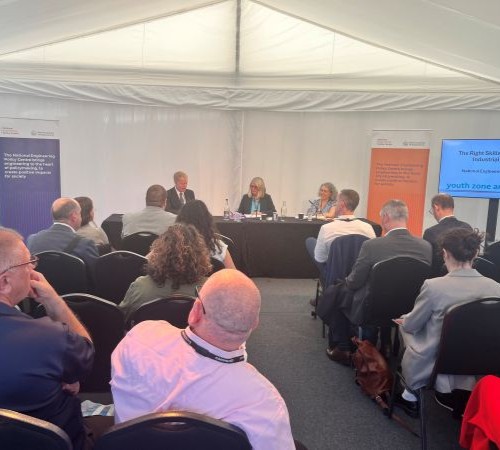
National Engineering Policy Centre event at the 2026 Labour party conference
This year our events tackled issues around engineering skills policy. Our Labour event, How do we make sure that the UK has the right skills to deliver the Industrial Strategy, was a ‘fireside chat’ between Baroness Jacqui Smith, the Minister of State for Skills, James Partington, the Director of Engineering Policy and Impact from the Institution of Mechanical Engineers, and Engineering UK CEO Dr Hilary Leevers.
With vocational education forming a key part of the Prime Minister’s agenda, the session with Baroness Smith started by discussing Andy Burnham’s ambitions for education and skills policy. The conversation then moved through an analysis of the impact of the devolution on education delivery, the importance of balancing labour market needs with student choice, and the impact and opportunities of skills policy now being split between the Departments of Education and Work and Pensions. The Baroness trailed a forthcoming white paper that would tackle the specifics of the devolution agenda before speaking warmly of Burnham, saying that the centrality of skills reform to his ambitions was set to make her job in government far easier.
Meanwhile, our panel event at Conservative Conference examined How to deliver the right engineering skills to drive economic growth in every corner of the UK. Chaired by EngineeringUK Head of Policy and Public Affairs Beatrice Barleon, it featured an expert lineup of Shadow Education Minister Rebecca Smith MP, Dan Hooper - the Vice President for Government Relations at Rolls-Royce, and Lydia Amarquaye-Booker, Education and Skills Policy Lead from the Institution of Mechanical Engineers.
The discussion quickly turned to engineering skills shortages, and how a Conservative Government would seek to address this challenge. The panel highlighted the central role that industry partnerships will need to play in tackling this. Panellists considered the Conservatives’ ambition to create 100,000 more apprenticeships, including the practical support businesses would need in order to offer more high-quality opportunities. Drawing on Rolls-Royce’s experience, the conversation explored how employers can work with schools, colleges and other education providers to signpost opportunity and build a reliable pipeline of skilled workers, while also highlighting the difficulties businesses can face in providing meaningful work experience placements.
The panel also discussed the need to broaden participation in engineering, bringing more women into engineering careers, and emphasised the importance of clear communication and visible role models in showing more people that engineering can offer an attractive and rewarding job.
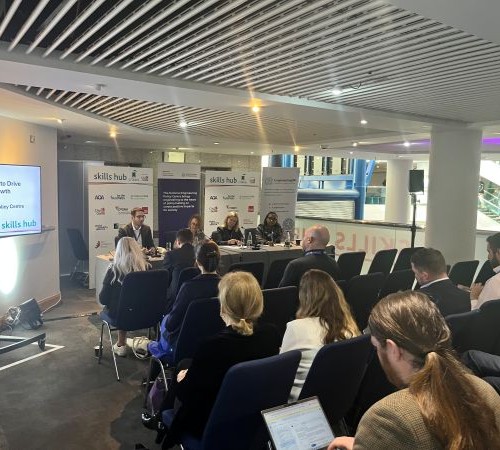
National Engineering Policy Centre event at the 2026 Conservative party conference
In addition to our own events, there was a host of fringe panels, interviews and receptions for us to attend. With the Labour Party sporting a new leader at this conference, much of the fringe focused on his priorities coming into government, especially as pertained to the devolution agenda. But many topics persisted from previous Labour conferences, with events tackling Net Zero, skills reform, and artificial intelligence all to be found on the agenda. The Prime Minister’s speech on conference on the Tuesday summed up the themes of the previous days. Over the course of an hour, he touched on apprenticeships, upgrades to the UK’s power grid, efforts to bring national infrastructure back into public ownership, and his overall ambition to provide the UK economy and UK society in general with what he called a ‘circuit breaker’.
At the Conservative fringes, it was possible to hear discussions on energy policy, the potential of AI, tech sovereignty and leveraging pensions capital to drive investment and economic growth. And with the party continuing to set out its new offer to voters, the fringe gave attendees a glimpse of the direction that further announcements might take. In her speech, Leader of the Opposition Kemi Badenoch promised tax cuts, and a removal of regulation – including on planning and energy, to spur growth. Badenoch also set out plans to reduce youth unemployment by encouraging job creation and encouraging people into work.
A lot has changed since Parliament’s composition shifted so dramatically at the last General Election. Both Labour and the Conservative have spent the last two years thinking hard about what each party can offer the electorate and the product of that thinking was on offer across each party’s conference agenda. With 2029 coming fast into view, it won’t be long before that thinking solidifies into manifestos ahead of the next electoral battle.
Related content
Futures and Dialogue
Using foresight techniques and engaging with the public and other stakeholders to inform policy and policymakers.
Why faster, better digitalisation is critical to UK energy goals
A new report from the National Engineering Policy Centre urging for prioritisation of digitalisation to secure Clean Po…
Net zero
Addressing climate change is a major challenge of the 21st century. At the Academy, we’re taking a systems approach to…