
Research Fellowships 2026
The challenge
Floating offshore wind is central to the UK’s net-zero strategy, as 80% of offshore wind resources lie in waters too deep for fixed foundations. Unlike commercial fixed-bottom turbines, floating wind is still relatively nascent, with projections of a thousand-fold scale-up requiring 17,600 additional turbines, each comparable in size to the Eiffel Tower. To achieve this scale-up, step-change reductions in cost of the floating platforms are needed, since they are four times more expensive than fixed-bottom foundations. In contrast to the wind turbine sitting atop the floating platforms, there is no convergence on the floating platform design, suggesting substantial scope for further innovation and cost reduction.
The research
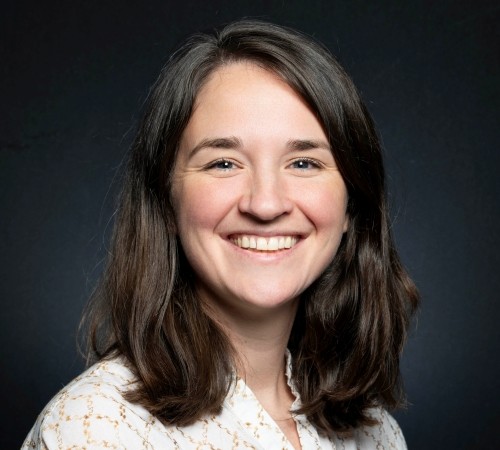
Dr Emma Edwards’ fellowship will answer the question ‘how can floating wind platforms be optimised to deliver high power at low cost?’. Building on prior work showing hydrodynamic optimisation can cut costs by reducing surface area, mass, and fatigue loads, the project will exploit the dependence of wave-structure interaction on body geometry to uncover radically new designs.
The project will be split into two parts: (1) discovery of theoretical optimal geometries, using analytic and novel numerical methods; and (2) evaluation of practical constraints, such as survivability and manufacturability. Dr Edwards’ group will work with industry partners to establish 1-2 viable concepts with reduced mass and higher energy yield than existing platforms.
The researcher
Dr Edwards received her PhD in Mechanical Engineering from Massachusetts Institute of Technology in 2020, for her thesis titled ‘optimisation of the geometry of axisymmetric point-absorber wave energy converters.’ She was a postdoctoral researcher at the University of Plymouth for two years, working on floating wind platform design and physical modelling, as well as continuing work on wave energy converter geometry optimisation.
She now runs a research group at the University of Oxford, working on a range of fluid mechanics problems applied to offshore renewable energy, focusing on analytical, numerical and physical modelling of floating wind and wave energy. She is motivated by mathematical research that addresses real-world challenges and improves lives, and she is particularly passionate about increasing the representation of women in engineering.
Related content
View all programmesSupport for research
The Academy runs a number of grants to support excellent researchers carry out engineering activities and to enable clo…
Research Fellowships
Our Research Fellowships support outstanding early-career researchers to become future research leaders. Applications f…