
Research Fellowships 2026
The challenge
Emerging applications in flight, freight, and defence require batteries that store considerably more energy than those currently available. Lithium-metal batteries offer a compelling route forward, storing more energy than conventional lithium-ion cells. Their performance, however, is constrained by the electrolyte – the material that transports lithium ions between the battery's electrodes. The electrolytes in widespread use today are incompatible with lithium metal as they permit the growth of tiny needle-like structures, called dendrites, that pierce the electrolyte and cause the battery to fail. Overcoming this barrier is essential to realising lithium-metal batteries as a commercial technology.
The research
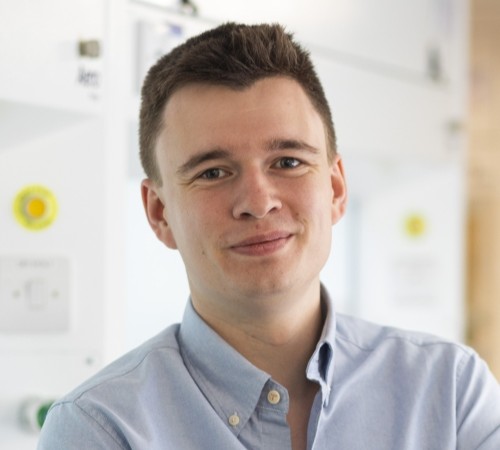
Dr Dominic Spencer-Jolly's research develops new electrolyte materials that are compatible with lithium-metal anodes and that are able to suppress the dendrites that cause conventional cells to fail. Alongside this, his work uses advanced X-ray and neutron imaging at national facilities to watch batteries as they charge and discharge, revealing how and where failure begins deep inside working cells. Understanding these mechanisms allows him to move beyond trial and error, turning observations of failure into clear design rules for better materials. Through his fellowship, he aims to establish the scientific foundations needed to make durable, high-energy lithium-metal batteries a practical reality.
The researcher
Dr Spencer-Jolly is an Assistant Professor in the School of Metallurgy and Materials at the University of Birmingham, where he is co-lead of the Energy Materials Group. His team are focused on researching next-generation battery materials and interfaces, with a particular focus on all-solid-state and semi-solid-state batteries.
Related content
View all programmesSupport for research
The Academy runs a number of grants to support excellent researchers carry out engineering activities and to enable clo…
Research Fellowships
Our Research Fellowships support outstanding early-career researchers to become future research leaders. Applications f…