
Background
The Academy is collaborating with key engineering and gender equality organisations to drive systemic action to increase girls’ progression into engineering and technology. In 2024, the Academy joined with EngineeringUK, the Women’s Engineering Society, Women in Science and Engineering, and BCS (the Chartered Institute for IT) to establish the Gender Pathways into Engineering and Technology collective.
The core group that currently leads the collective also includes the British Science Association, Capital City College, Digit<all>, Orbyts, Tech She Can, and UCL. The project brings together around 60 organisations around increasing the numbers of girls and young women on educational pathways into engineering and technology.
On 7 September, the collective’s policy document 40 by '40: Gender equity in engineering and technology education’ was published. This is a blueprint for action by policy-makers, particularly the Department for Education, to work towards the aim of young women making up at least 40% of young people on educational pathways into engineering and technology careers, by 2040.

Image: EngineeringUK 2026
As the national Academy for engineering, we provide progressive leadership for engineering and we prioritise equity, diversity and inclusion (EDI). Securing more balanced gender representation in engineering is an important driver of our EDI work and we proudly support the aims of the Gender Pathways project.
There’s more information on the project and the 40 by '40 Blueprint on the EngineeringUK website.
...fully addressing the under-representation of women in the digital economy could deliver an increase in total GDP of around £4 billion per annum.
The Economic Impact of Equal Opportunities in the Digital Economy, published by the Department for Science, Innovation and Technology (DSIT) on 6 July 2026
The education pathways into engineering and technology covered in this report are:
- Education from primary school age onwards, particularly STEM education and introductions to STEM careers
- relevant STEM subjects at GCSE
- post-16 education up to the age of 18, including
- A Levels like computing, design and technology, maths and physics
- T Levels in engineering and technology related subjects
- Vocational qualifications like BTECs in engineering, construction or digital subjects or future V Levels
- Engineering and technology apprenticeships up to age 18.

Image: EngineeringUK 2026
An engineering community fit for the future: girls are future engineers and technologists
Our blog, authored by the Academy’s Head of Equity, Diversity, and Inclusion (EDI) Joanna Whiteman, and Senior Manager, EDI Karen Grayson, sets out the importance of the gender pathways project, and other ways the Academy works to advance EDI in engineering; and urges the Department for Education to promote gender equity in schools.
Inequities in the education system
Girls are significantly underrepresented in academic and vocational pathways into engineering and technology. In 2025, only:
- 22.6% of Computing GCSE entries were by girls (England, Wales and Northern Ireland, 2025) [1].
- 24.1% of Physics A level entries were by girls (England, Wales and Northern Ireland, 2025) [2].
- 19% of Computer Science A level entries were female (England, Northern Ireland and Wales, 2025)[3].
Gender imbalances are particularly pronounced in many vocational pathways.
- Among 16- to 18-year-olds taking engineering and technology-related vocational qualifications (other than T Levels) in England in 2024/25, 12.5% were girls [4].
- 12% of engineering and tech-related T Level students were female (England 2025) [5].
- 10.5% of 2024/25 engineering and technology apprenticeship starters up to 24 years old were young women (England, 2025) [6].
Recommendations
We are asking the government to embed long-term, sustainable interventions to improve gender equity in education and skills. The top-level recommendations are:
- It must ensure that teaching and pedagogy support girls on STEM pathways.
- It must work with other relevant departments to ensure gender-equitable delivery of engineering and technology careers guidance, enrichment and work experience.
- It must work with other departments, including the Office for Equality and Opportunity, to foster a culture of gender equity in schools and colleges.
The recommendations are explored in greater detail in the full '40 by 40: Gender equity in engineering and technology education' report.
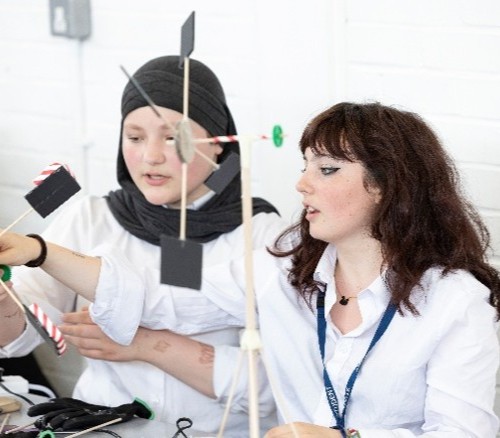
Image: EngineeringUK 2026
Contact us
For further information about this project or if you have questions, please contact [email protected].
[1] EngineeringUK (2025) GCSE and Scottish National 5 results day briefing 2025
[2] EngineeringUK (2025) A level and Scottish Highers results 2025 report
[3] EngineeringUK (2025) A level and Scottish Highers results 2025 report
[4] EngineeringUK (2026), Context setting paper: gender pathways into engineering and technology
[5] EngineeringUK (2025), T Levels results 2025
[6] EngineeringUK analysis of the Department for Education’s apprenticeships data.
Related content
EDI Engine: Business benefits of equality, diversity and inclusion in engineering
Discover compelling evidence and actionable insights on the benefits of equality, diversity and inclusion (EDI) to engi…
Equality, diversity & inclusion in engineering literature review: A decade in focus
Read our literature review examining the evidence on equality, diversity, and inclusivity (EDI) in UK engineering from…
Graduate Engineering Engagement Programme
GEEP supports UK engineering students and recent graduates from under-represented backgrounds into engineering careers.…