
Drawing on our Practical AI workshop hosted by Academy President, Sir John Lazar CBE FREng and co-chaired by Professor Nick Jennings CB FREng FRS and Dr Angie Ma, this explainer examines what reliable deployment of agentic AI would require in engineering.
It considers multi-agent coordination, the interaction between agents and their engineering environment, whole-system assurance, meaningful human oversight, and the skills engineers need to work effectively with these systems.

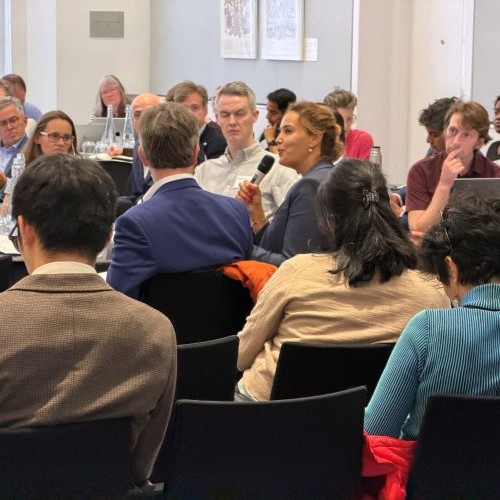
Practical AI Agentic AI workshop at Prince Philip House
What is agentic AI?
Agentic AI systems can pursue objectives over multiple steps, using tools, taking actions and adapting in response to what happens. Engineering applications provide a demanding test because these systems may interact with physical assets, operational processes and make or inform consequential decisions that can’t easily be reversed.
Why it matters now
The government has set an ambition to “reindustrialise with AI”. To deliver, AI will need to improve how systems are designed, made, operated and maintained. Across factories, infrastructure networks or transport systems, it must work dependably within and across engineering processes.
The opportunity is significant. The engineering economy contributes up to £747 billion in direct GVA each year - over a third of UK economic output. Yet adoption of advanced AI remains uneven across the sector. The Academy's Technology Adoption Index, revealed the current state of Industry 4.0 uptake across UK engineering companies.
Technology Adoption Index insights
Number of engineering and technology companies analysed in the index
Proportion of firms that showed no confirmed evidence of adoption of any ten industry 4.0 technologies
Proportion of firms using AI and cognitive learning at a level likely to produce significant productivity gains
The agent inherits the engineering environment
An agent can act only on the world made available to it. Reliable deployment depends not just on the model, but on the data, tools, interfaces, permissions and feedback mechanisms around it.
For that reason, evaluation and assurance need to cover the whole deployed system and the sequence of actions through which it reaches an outcome. In multi-agent settings, this also includes how agents authenticate and exchange information, how conflicts are resolved, and how roles are allocated and accountability maintained across organisational boundaries.
Specify the human role
“Human in the loop” is not, by itself, a meaningful safeguard. Effective oversight depends on what the person is expected to decide, what evidence they receive, and whether they have the expertise, time and authority to intervene.
Systems should combine constrained permissions, automated checks and monitoring to enforce routine boundaries, then pause, summarise and escalate at points where human judgement can still change the outcome. These arrangements must match the speed and volume of agent activity - otherwise, review can become a procedural sign-off rather than an effective control.
Priorities
- Build shared foundations for assurance and security. Government should connect existing institutions and funding to develop and validate common reference tasks, measurement methods, test environments, logging conventions and reusable evidence templates. These foundations should reduce the cost of assurance, particularly for smaller adopters and suppliers, while allowing private providers to tailor services to particular sectors and use cases.
- Commission deployment-focused engineering demonstrators. Government should work with industry, national laboratories, universities and test facilities on a small number of high-value operational problems. Demonstrators should use representative data, workflows and measurable baselines, and produce reusable evidence on performance, authorisation boundaries, multi-agent coordination, human oversight at realistic speed and scale, failure modes, integration costs and economic viability. Success should be judged by whether the next adopter can deploy at lower cost and with less uncertainty.
- Educators, professional bodies and employers need to define the capabilities needed for human-agent and multi-agent work, embed them in education, training and continuing professional development, and create safe opportunities to practice them.
Blog series: Engineering Responsible AI
This programme explores themes around the safe and ethical development and deployment of AI through interviews with AI…
Practical AI
Practical AI describes the responsible integration of AI into everyday infrastructure and services to deliver measurabl…
Engineering policy
The Academy provides independent, authoritative advice to government. The Academy also responds to Parliamentary, gover…