
European engineering leaders discuss infrastructure at Euro-CASE
EU Commissioner Michael McGrath has issued a timely reminder to engineering leaders from across Europe and the UK that “resilience is not only about protecting infrastructure, it is about protecting what infrastructure makes possible: security, trust, freedom and democracy itself.”
Opening a major European engineering leadership conference in Belfast, Commissioner McGrath challenged Europe’s top engineers to explore how to protect the physical and digital infrastructure underpinning modern society amid growing risks, geopolitical tensions and increasingly interconnected systems.
The annual conference of the European Council of Academies of Applied Sciences, Technologies and Engineering (Euro-CASE) is jointly hosted for the first time by the Royal Academy of Engineering and the Irish Academy of Engineering.
It brings together hundreds of engineers and scientists to address some of the increasingly common vulnerabilities of our key infrastructure, following recent failures and threats including power outages, transport disruption, cyberattacks and extreme weather.

Engineering resilience: Securing Europe’s critical infrastructure
The programme for “Engineering resilience: Securing Europe’s critical infrastructure in a changing world” is built around four key stages of resilience planning: preparation, prevention, recovery and rethinking.
- Session one - preparation: Looks at horizon scanning for future threats, with a keynote address from retired Vice Admiral Mark Mellett DSM, former Chief of Staff of Ireland's Defence Forces. Other panellists include Katie Barnes, Executive Director of the National Preparedness Commission UK, and Andy Lord, Commissioner of Transport for London.
- Session two - prevention: includes contributions from Dave Murphy CEng FIEI, President of Engineers Ireland and Professor Donna O’Shea, Chair of Digital Engineering at the University of Limerick.
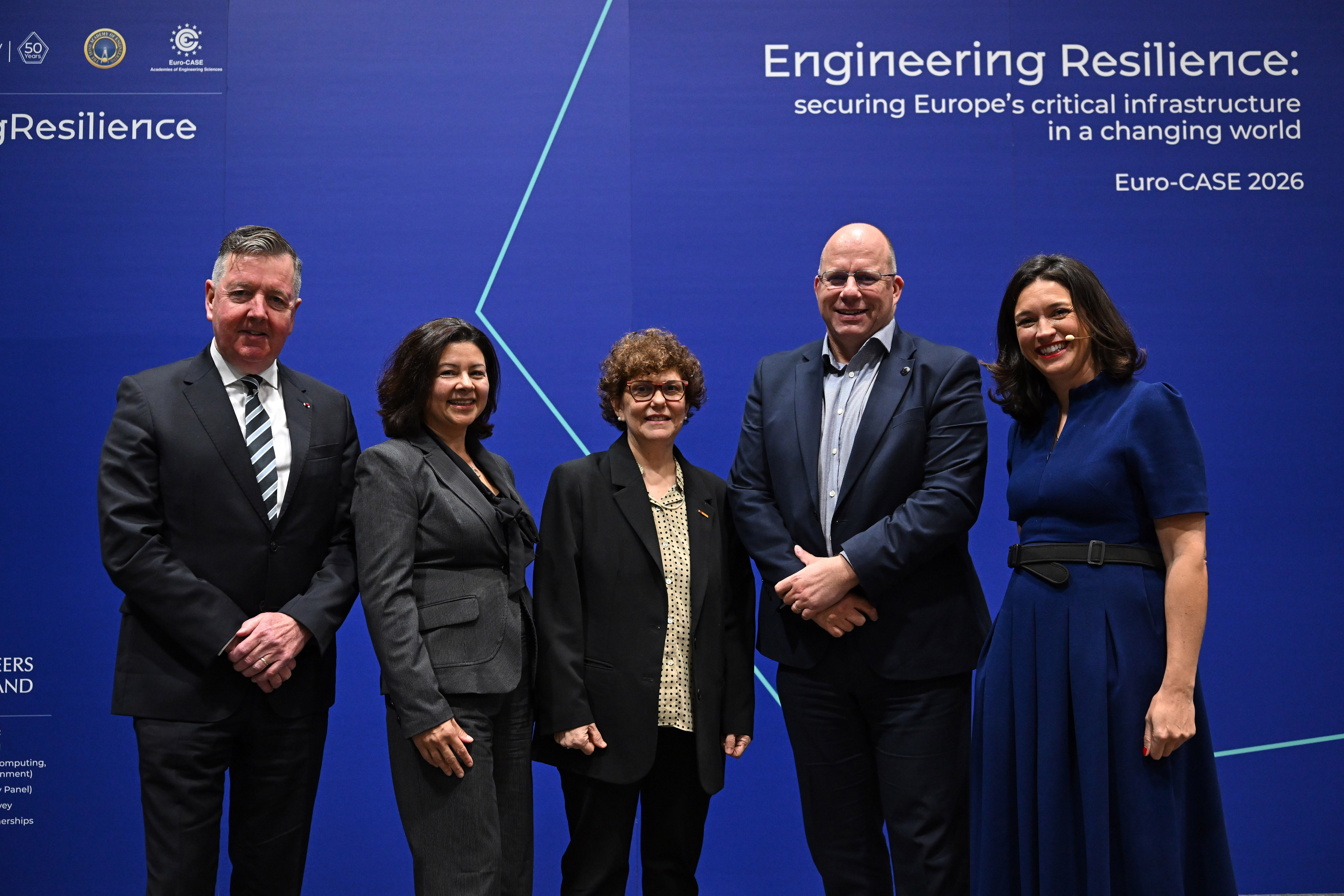
Left to right: Vice Admiral (retired) Mark Mellett DSM, Katie Barnes, Professor Dimitra Simeonidou, Andy Lord & Katie Prescott
- Session three - recovery and learning from failure: this session includes a keynote from Dr Joshua Macabuag OBE FREng, the CEO of Renew Risk and Patrik Fältström, a senior Security Consultant at Netnod will also be speaking.
- Session four - rethinking resilience: the final session is chaired by Dr Sarah Prichard from Buro Happold and includes Professor Máire O’Neill, Regius Professor in Electronics and Computer Engineering at Queen’s University Belfast, Dr John W. Flanagan, Former City Engineer & Assistant Chief Executive of Dublin City Council and Cathal O’Rourke, Group Chief Executive Officer of Laing O’Rourke.
Alongside the main conference, a public exhibition will showcase examples of regional engineering innovation, supported by the Royal Academy of Engineering’s Enterprise Hub Northern Ireland. Exhibitors include Oxford Instruments, Denroy, Creagh Concrete and Ribbon Medical. Free to the public, around 200 secondary school children from across Northern Ireland are also expected to attend the exhibition and get hands-on experience of new technologies.
Jorge Iván Contreras Cardeño will facilitate a resilience game created by the Resilience Centre in Denmark. The hour-long game will test people’s understanding of resilience planning as they create a plan which is then tested by an unknown scenario.
Bringing engineering leaders together
Sir John Lazar CBE FREng, President of the Royal Academy of Engineering, said:
“Bringing engineering leaders together in Belfast provides an important opportunity to share expertise and consider how we can build infrastructure that is better prepared for the risks and uncertainties of a changing world. Climate change, ageing assets and rising cyber threats are placing increasing pressure on the systems that underpin everyday life. Because our energy, water, transport and digital systems are so closely connected, disruption can cascade rapidly from one service to another.
“We need to enrich public and policy debate with engineering thinking. Up until now that has mostly been hidden from view, but as resilience is increasingly tested, the trade-offs and understanding of how these systems operate has to be part of a national and European conversation about how we build more resilience into our critical infrastructure.
Sean Finlay FIAE, President of the Irish Academy of Engineering, said
“Ireland cannot build resilient infrastructure by looking at roads, energy, water, ports and digital networks in isolation. We cannot eliminate every risk, but we can identify where failure would have the greatest consequences and take proportionate action before disruption occurs.
“Independent engineering expertise, sustained investment and time-bound programmes with clear responsibility for delivery and maintenance will be essential to strengthen resilience for the decades ahead.
“International collaboration is essential for delivery of integrated infrastructure and the Irish Academy of Engineering is delighted to collaborate with its UK counterpart the Royal Academy of Engineering in hosting the Conference of European Academies of Engineering (Euro CASE) in Belfast this week.”
Notes for editors
- The Euro-CASE Annual Conference 2026 took place on 19 November 2026 at ICC Belfast.
- The European Council of Academies of Applied Sciences, Technologies and Engineering brings together national academies of engineering and related disciplines from across Europe. Its annual conference fosters international exchange on key future issues in applied science, technology and engineering. This conference is sponsored by Engineers Ireland and supported by the UK Government’s International Science Partnerships Fund, Euro-CASE, Ulster University, Belfast City Council, Matrix and the British Geological Society.
- Euro-CASE 2027 is due to take place in Porto, Portugal on 28 October. The theme of the conference will be: Engineering the Future - Driving EU Competitiveness and Societal Progress.
- The Irish Academy of Engineering published ‘Improving the Resilience of Critical Infrastructure on the island of Ireland’ in November 2026.
- The Royal Academy of Engineering creates and leads a community of outstanding experts and innovators to engineer better lives. As a charity and a Fellowship, we deliver public benefit from excellence in engineering and technology and convene leading businesspeople, entrepreneurs, innovators and academics across the profession. As a National Academy, we provide leadership for engineering and technology, and independent, expert advice to policymakers in the UK and beyond.
Our work is enabled by funding from the Department for Business, Innovation, Science and Trade, corporate and university partners, charitable trusts and foundations, and individual donors.
Press and media centre
Information and resources for journalists looking for advice and experts for interview on key issues across the whole f…
News
Read the latest news releases from the Academy relating to our engineering projects and initiatives, our latest reports…
Reviving our ageing infrastructure report
This 2025 National Engineering Policy Centre report outlines the critical challenges faced by our ageing infrastructure…