

Dr Heather Smith is a senior lecturer in water governance at Cranfield University. Her research explores the governance, institutions and societal dimensions of the water and wastewater services sector and has a particular interest in the relationship between governance and resilience.
The Academy’s Policy team spoke to Heather about the ethical considerations that underpin responsible water and wastewater management, and the practical steps engineers can take to ensure these systems are designed and delivered correctly.
What is water and wastewater management?
Water and wastewater services involve the supply of clean drinking water and the collection and treatment of used water and sewage. There are a range of roles in the sector which work to apply engineering principles for the effective selection, design and operation of water and wastewater assets and assess performance, environmental impact, energy, risk and cost. The UK’s infrastructure is facing growing challenges, including from population growth and climate change, making economic and environmental resilience now more urgent than ever. Water and wastewater are essential services, and the direct impact of the sector can raise social and ethical responsibilities for the people who work within it.
What are the critical ethical issues in this area?
There are two big ones at the moment. The first is the extent to which we rely on the environment to support our water and wastewater services, and how much we can continue that. Secondly, if we’re going to remove our reliance on natural environments and use engineered systems, what is the fairest way to pay for that.
We have always relied on the environment as a resource for our water and as a sink that can absorb our waste. The creation of modern wastewater systems is a more recent extension of that, where we use discharges into the environment to dilute and process our wastewater. Over generations, we have replaced our reliance on the environmental sink with our own investments, for example by developing wastewater treatment facilities to remove contaminants and alleviate the pressure on natural systems that receive discharges. But this still involves discharging some waste, and though its highly treated, we are relying on nature to do the rest. Sometimes those treatment facilities are bypassed, as in the case of overflows, when untreated wastewater can be discharged if sewer systems become overwhelmed.
Our local environments cannot always cope with these discharges, and we’re seeing rising public concern about this. In many cases we need upgrades in the treatment and processing of our waste, for both public health reasons and to manage environmental pollution, to reduce our reliance on that environmental subsidy.
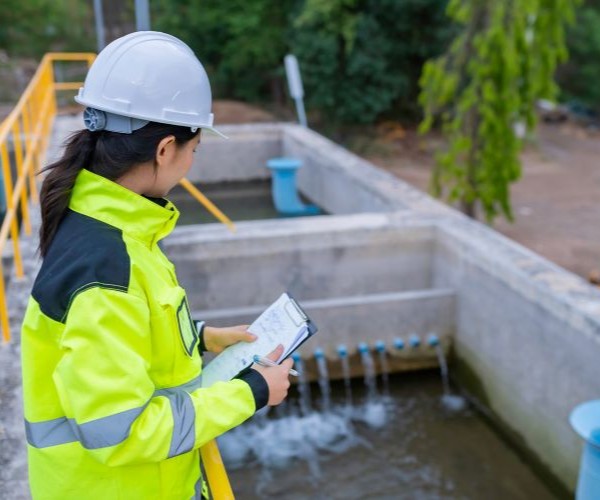
In many cases we need upgrades in the treatment and processing of our waste.
Why are these ethical issues particularly important?
If we want to reduce our environmental impact and our reliance on natural systems for water and wastewater services even further, questions arise around who bears the cost. People are concerned about rising bills, but managing our infrastructure properly has a cost, so we need to find a way to distribute that cost fairly. In the sector there is a heavy reliance on debt to finance asset needs, and this can kick the cost down the road to be covered by the next generation. But the next generation doesn’t get a say in how we spend money now, so we need to think about the fairness of this approach. It is important that we are having this discussion around what we need and how it will be paid for now.
Infrastructure decisions are made by water companies and the regulators, but how and what the sector is investing in is starting to receive much more public attention. There are reforms currently being planned that may start to shift thinking on priorities and there is a role for the engineering community to offer input on what is involved in delivering intended outcomes and realistic costs and timescales.
Which of the ethical principles are most important here?
Responsibility for the future of technology, society, and the environment is a crucial principle for this sector, especially regarding efforts to mitigate the environmental impact of our water and wastewater needs. There have been huge advances in technologies for wastewater treatment, which can limit risks for pollution but may also introduce trade-offs with cost and energy demand. With growing pressure to eliminate overflows, we need to understand the implications of decisions in the system and find a way to balance those competing environmental and public health risks. Water companies and regulators don’t always have guidance to resolve competing priorities. Engineers will have a role to understand and advise on the extent to which trade-offs can be minimised, and how to manage trade-offs more effectively. While they cannot be removed entirely, we can find some win-win solutions, for example new developments in low energy treatment processes.
This must also be underpinned by the principle for accuracy and rigour. There is more data available now, but we are often seeing misinterpretation of that data which can impact on decisions and foster an unnecessarily negative narrative. We must ensure that accurate information is being shared that represents the full picture of what’s happening, and be proactive in helping people to understand what the data is showing.
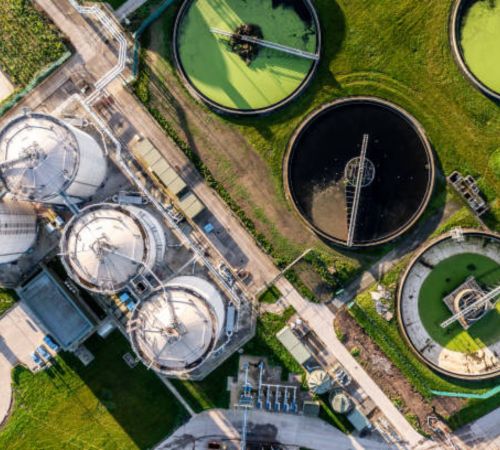
We must ensure that accurate information is being shared that represents the full picture.
What can engineers do differently on this issue?
Traditionally, the water sector has been considered a “quiet” service, receiving little attention unless there is a specific incident. Being invisible was seen as a mark of success. This engenders a feeling among those within the sector of wanting to keep their heads down, but with a growing public consciousness around the state of our systems and the impacts the sector has, there needs to be a shift in this mindset. The engineering community can have a role in the public debate to raise awareness and understanding so that it is open and fair.
There is a need for engineers to get more engaged in the public and political conversations about our water and wastewater systems and what we expect them to be able to deliver, so that these are based around robust evidence and the real conditions of our systems.
What are the risks of doing nothing?
What we risk is a having a continuing toxic narrative, ideologically driven and not brought back to an evidence-based, honest discussion about the reality of what is needed to deliver improvements. I worry that this situation, with mounting public and political pressure, will keep us on a very short-term focus which means that we are not building system resilience. This could mean we’ll be kicking the costs and issues down the road even more.
We need to be thinking now about decisions on big infrastructure such as reservoirs and water recycling schemes, because these are not quick solutions but they will have a big impact on how our system works in the future. But short-term conversations can keep delaying these decisions, and in future we could find ourselves wishing that we had already started investing years ago to ensure the stability of our services.
Given the challenges seen in our ageing infrastructure, we’re already at the receiving end of significant costs based on historic decisions (or delays in decisions). Ethical practices should be driving us to make changes now but if we do nothing then future costs will only continue to rise.

Ethical practices should be driving us to make changes now, but if we do nothing then future costs will only continue to rise.
What challenge would you set any engineer working in this area?
Get engaged in the conversation. There are ways to get involved in the public discussion and this can influence political priorities. Going to events, speaking publicly, and supporting outreach can make a big difference in the overall conversation. We also need to ensure that we are supporting leaders to make informed choices so I would encourage engineers to be looking out for government consultations and getting involved in giving evidence when it’s asked for. We have a real opportunity now to have a rethink about how we do things – there are good signals from government for delivering meaningful change and we shouldn’t miss the strong political attention while we have it.
Working with water and wastewater systems is not typically seen as the most attractive career route, but if people want to make a difference in a sector that really needs it and is fundamental to our way of living, then water is the way to go. I hope sector-specific courses are being promoted at the undergraduate level and considered by aspiring engineers.
Related content
Engineering Ethics: Q&A with Richard Maudslay
Richard Maudslay, Director of Laser Light, explores the ethics behind insulating homes.
Engineering Ethics: Q&A with Professor Susan Gourvenec
Susan Gourvenec, Professor of Offshore Geotechnical at the University of Southampton, explores the ethics behind offsho…
Engineering Ethics: Q&A with Professor Malcolm Macdonald
Malcolm Macdonald, Professor of Applied Space Technology at the University of Strathclyde, explores the ethics behind t…